So the war is underway, and with it has come no small amount of
second-guessing. But I'm not talking about the reconsideration
of the war plan that has come along with the discovery that people
tend not to like you when you invade their country and blow up
their houses and kill their families and stuff. I'm talking about
the articles I've run across that ask, "Hey, Nader voters! Wish
you had your vote back now? Still think there's no difference
between Bush and Gore now that we're repeating the Gulf War,
fuckers?" Good question. Let's think about where we might be
today had history gone a little differently.
It's the morning after Election Day, and while he's won comfortably
in the popular vote, Al Gore has just barely squeaked through with
a victory in the electoral college. Immediately the Republicans
press for recounts in Florida... and Iowa, and Oregon, and Wisconsin.
Endless recounts are authorized 5-4 by the Supreme Court, and
seemingly endless they are, as the GOP tries to find a formula that
will tilt these states to Bush. ("We'll count the military absentee
ballots, but not the regular ballots where the chads weren't entirely
removed...") Indeed, they continue even after President Gore is
sworn in. (Compare Bob Dornan's attempt to wrest his congressional
seat back from Loretta Sanchez for nearly a year after the election.)
After it becomes clear that the recount numbers will always favor
Gore, the Bushies switch tactics and argue that Gore's victory was
due to fraud. Who knows what dirty tricks went down in those
ethnic precincts? The Democrats stole the election!
The controversy wouldn't die down the way it did in our 2000, either;
while we have only the occasional reminder from Michael Moore that
Bush is a "fictitious president," in this alternate happentrack you
can rest assured that Rush Limbaugh, Bill O'Reilly and company would
be hammering this theme home every day without fail. 62,400 repetitions
equal one truth. This is one of the key asymmetries in America today:
while rich Democrats kick around the idea of giving Al Franken a radio
show as the solution to the left's inability to spread their memes,
the far right trots out demagogue after demagogue and tens of millions
hang on their every word.
Between the "Gore stole the election" mantra and the sputtering economy
(for nothing could really have prevented a recession after the tech
bubble popped) — not to mention a Congress with both houses in
the opposition, for Jim Jeffords doesn't flip without being jerked
around by the Bush Administration — the Gore presidency would
have been crippled from the get-go. Of course, Bush wasn't doing
much better for most of 2001. Then came September 11th. Does the
nation rally around President Gore? I doubt it. This is another
asymmetry, you see: the Republicans are perceived as the more
patriotic of America's two major parties, and there seems to be
little that can tarnish this notion. Superpatriots like Trent Lott,
Don Nickles and Tom DeLay spent much of the Clinton Administration
making remarks that they call treasonous when Tom Daschle levels
them at Bush. Would they have stood behind President Gore when
the World Trade Center collapsed? Hardly. "THE DEMOCRATS HAVE
BEEN WEAKENING THIS COUNTRY FOR YEARS AND NOW LOOK WHAT'S HAPPENED!"
they'd have screamed. "THIS WOULD NEVER HAVE HAPPENED IF GEORGE W.
BUSH WERE PRESIDENT!"
And Gore would be in a no-win situation. For here we reach asymmetry
number three. No one worried that a Republican president's response
to a major terrorist attack on the US would be too dovish. In
mid-September of 2001, people had two fears about George W. Bush:
that he'd nuke pretty much the entirety of the Middle East, or that
he'd freeze up like Cindy Brady on a game show. When he put off
invading Afghanistan for a full month, and didn't dump the presidency
on Cheney and run screaming back to Texas, people suddenly viewed him
as a statesman. Gore, on the other hand, would have the opposite
problem. He wouldn't have people urging him not to do anything
rash; he'd have people screaming, "DO SOMETHING!" But no matter
what he did (short of, say, nuking pretty much the entirety of the
Middle East) he'd face withering criticism from both sides. Say he
did the same thing Bush did: take a month to develop a plan, then
begin a bombing campaign in Afghanistan while offering support to
the Northern Alliance against the Taliban. Those who had held their
noses and voted for Gore instead of Nader in this happentrack would
break out their "NOT IN OUR NAME" signs, pointing out that if they'd
wanted a president who was going to kill civilians (more Afghan
civilians were killed by US bombs than the total death toll at the
World Trade Center) and cozy up to tyrants such as Uzbekistan's
Islam Karimov (who's been known to kill his opponents by boiling
them to death), they might as well have thrown the election to Bush.
Meanwhile, critics on the right would insist that Gore wasn't doing
nearly enough. "If George W. Bush were president al-Qaeda would be
finished by now!" they'd proclaim before the month was out. "No
more Clintonian half-measures! Impeach Gore! Our freedom is at
stake!"
Now, true, there's a list of Bush travesties that we wouldn't see
under a Gore Administration: a ridiculous tax cut for the ultra-rich,
a manufactured war on Iraq, an alarming erosion of our civil rights,
and let's not forget the scorn of the world. But it wouldn't matter.
Less than a year into his administration, Gore would be Jimmy Carter
redux. While in the real 2002, the Democrats, cowed by the fear of
seeming unpatriotic, unveiled a campaign pitch that went "the president
is peachy keen except we would also like a prescription drug benefit,"
the Republicans in this alternate 2002 would run on a platform of "the
Democrats stole the election, led us into recession and got half the
east coast bombed." They would clean up in the midterm elections.
The next day the Bush 2004 campaign would launch. And when Bush took
office in January 2005, his party would have, what, maybe seventy
senators to its credit? Not to mention a team ready to invade Iraq
by mid-March.
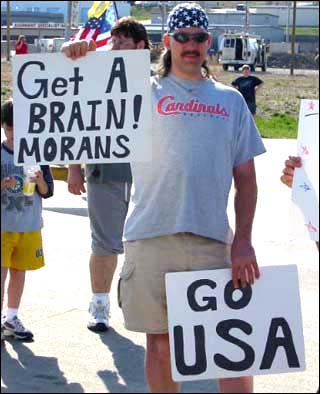 See, a lot of people on the left seem to be under the impression
that Bush is an aberration, that if only we'd managed to fend him
off in 2000 it'd be smooth sailing for years to come. That
it was somehow a colossal mistake of some sort that America elected
a self-satisfied, none-too-bright religious zealot as its leader.
But Bush is not the problem. America is the problem. This is a
country populated by, if not a majority, then at least a significant
plurality of self-satisfied, none-too-bright religious zealots.
This is a country where the fundamentalist Left Behind series
is a runaway bestseller; where more than half the population thinks
the 9/11 hijackers were Iraqis; where you can't turn on the radio
or television without hearing a wave of racist invective and it's
considered just fine because the targets are the French. Note
that I'm not arguing that this makes the US any different from the
rest of the world — I'm well aware that the French don't seem
especially concerned by the attacks on French Jews by North African
emigres. The point is, there is an endless supply of
George W. Bushes in this country and the American public is more
than happy to elect them to high office. Have we forgotten Dan
Quayle? Have we forgotten Ronald Reagan? Have we forgotten Warren
G. Har— okay, I can understand forgetting Warren G. Harding.
What it comes down to is this: if Bush were the extremist interloper
some would make of him, a sort of American version of Jean-Marie
Le Pen, the problem would take care of itself, as Bush would have
no chance at all in 2004. (Compare northern New Mexico, where the
liberal 57% lost to the conservative 43% for a House seat in 1997
by splitting 40-17 Democrat-Green. That state of affairs lasted
until 1998.) If, on the other hand, Bush is fairly representative
of America as a whole, then a Gore win in 2000 would have just been
postponing the inevitable. I suspect the latter is the case. After
all, if Nader voters are responsible for the Democrats' woes, then
how'd the Democrats manage to lose seats in the Nader-free 2002
midterms? I get the sense that a lot of the grumblers are angry
because deep down they feel the Nader voters deprived them of four
final years before the Republicans took over forever.
See, a lot of people on the left seem to be under the impression
that Bush is an aberration, that if only we'd managed to fend him
off in 2000 it'd be smooth sailing for years to come. That
it was somehow a colossal mistake of some sort that America elected
a self-satisfied, none-too-bright religious zealot as its leader.
But Bush is not the problem. America is the problem. This is a
country populated by, if not a majority, then at least a significant
plurality of self-satisfied, none-too-bright religious zealots.
This is a country where the fundamentalist Left Behind series
is a runaway bestseller; where more than half the population thinks
the 9/11 hijackers were Iraqis; where you can't turn on the radio
or television without hearing a wave of racist invective and it's
considered just fine because the targets are the French. Note
that I'm not arguing that this makes the US any different from the
rest of the world — I'm well aware that the French don't seem
especially concerned by the attacks on French Jews by North African
emigres. The point is, there is an endless supply of
George W. Bushes in this country and the American public is more
than happy to elect them to high office. Have we forgotten Dan
Quayle? Have we forgotten Ronald Reagan? Have we forgotten Warren
G. Har— okay, I can understand forgetting Warren G. Harding.
What it comes down to is this: if Bush were the extremist interloper
some would make of him, a sort of American version of Jean-Marie
Le Pen, the problem would take care of itself, as Bush would have
no chance at all in 2004. (Compare northern New Mexico, where the
liberal 57% lost to the conservative 43% for a House seat in 1997
by splitting 40-17 Democrat-Green. That state of affairs lasted
until 1998.) If, on the other hand, Bush is fairly representative
of America as a whole, then a Gore win in 2000 would have just been
postponing the inevitable. I suspect the latter is the case. After
all, if Nader voters are responsible for the Democrats' woes, then
how'd the Democrats manage to lose seats in the Nader-free 2002
midterms? I get the sense that a lot of the grumblers are angry
because deep down they feel the Nader voters deprived them of four
final years before the Republicans took over forever.
And again, it's not as if we'd be living in some sort of utopia
under President Gore. Few voters who found Gore even tolerable
voted for Nader. For me, for instance, the deal was sealed when
Gore picked his running mate; it's said that a challenger's VP
choice is the electorate's first look at the sort of decisions we
can expect in the future, and Gore decided on the sanctimonious,
notoriously censorious corporate shill Joe Lieberman. But you
can't vote based on who you actually want to be president! the
Gore voters insisted. Don't be so naive! You have to vote
tactically! Fine. But why restrict those tactics to the short
term? Would you rather have four years of Gore and Lieberman followed
by Dubya, a filibuster-proof GOP Capitol, and the possible demise
of the Democratic Party? Or four years of Bush and a shot at
someone better than Gore in 2004? Of course, it remains to be
seen who the Democrats might pick. It could be John Edwards.
So help us, it might be fricking Lieberman. Don't even start!
the Gore voters bark. This time, you damn well are voting for
the lesser of two evils! Bush is a plutocratic warmonger who
thinks he's on a mission from God! The problem is, in
America, that might well be a winning campaign slogan —
for Bush.
Return to the Calendar page!
