
Chris Bergoch and Sean Baker, 2021
#6,
2021 Skandies
This is the movie from the 2021 Skandies list I was most looking forward to watching, because it’s by the Florida Project team, and I love The Florida Project. This one isn’t quite as good, but there is no doubt that it’s by the same folks: to use the terms drilled into us in the film classes I took in college, both the mise-en-scène and the montage of the two films are close to identical. That is, they look the same and the rhythms are the same. As for content, once again we’re in a not particularly affluent corner of the country—this time the Texas Gulf Coast, with oil refineries in the background of practically every shot—following the lives of not particularly affluent people. And once again we have a plot that masterfully parcels out information so that, without being overly gimmicky, we have to keep revising our sense of the story world. About half an hour in I thought that Red Rocket was a big step down from The Florida Project, but the twists kept coming, by which I mean both revelations about the backstory and the story events actually unfolding, and soon I was finding the movie quite involving. (As I recall, The Florida Project also felt like it took a while to get going.) I pause movies a lot, and mostly it’s because watching them has become a chore and I want to do something else for a while, like taking a break at work. But in the case of Red Rocket, at least by the second half, the reason I was pausing from time to time was more like not wanting to eat the whole box of chocolates in one sitting.
One of the big turning points of the film is that after thirty-five minutes spent among drug dealers and tatted-up prostitutes and haggard old women with missing teeth watching prolefeed on TV, several of the main characters go to a donut shop. The camera’s focus is on the characters we know and the way their interactions have evolved since the start of the film. While the cashier is perky and pleasant and well-scrubbed and therefore seems to have wandered in from a different movie, she is no more the focus of the scene’s attention than any other cashier in any other movie’s “main characters get food” scene. Here, look:
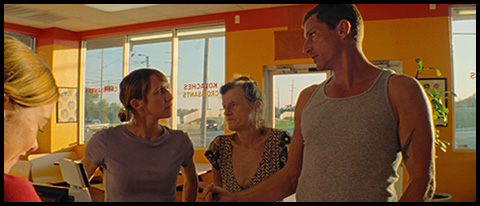
Sean Baker maneuvered me into thinking, “Hey, this random donut shop girl who will not be appearing in any other scenes is so much more appealing than the rest of these characters—too bad the movie isn’t about her”… and then suddenly the entire rest of the movie is about the donut shop girl. It’s a masterful example of Pattern 8. Ultimately, the movie is about the guy in the gray tank top, who has been revealed to be a big-name porn actor who finally aged out of his career after fifteen years, returning from L.A. to his Texas hometown to try to get back on his feet—and deciding that his ticket back into the industry is to lure this donut shop girl back to L.A. with him and turn her into the next porn superstar. As the film unfolds, we learn that she’s not nearly as innocent as she initially appears, and not only does the film, as described above, parcel out revelations to make us keep revising our understanding of the character, but it also uses Pattern 11 to perfection: it gives us the sense that there are limits to what might happen in this character’s scenes, and then surprising us by breaking though that false ceiling. Still, there’s a wide gap between “ingenue with a wild streak” and “professional sex worker”, and as he works to bridge that gap, we realize that, oof, our protagonist is basically Sport from Taxi Driver, updated by a few decades. (The movie is set in 2016, with Donald Trump and Hillary Clinton speeches occasionally heard in the background.) It’s something—like, if this guy hadn’t stepped off a bus, the donut shop girl might have gone to college. Or, since one of the hooks this guy uses to drag her in his direction is that she has sold nudes of herself online, she might have just started up an Onlyfans and stayed at home. One startling moment comes when we learn that she also plays music, singing a diegetic song for this guy that calls back to the non-diegetic music of the opening and retroactively lending it power—and I couldn’t help but think that if this guy had been involved with music rather than porn, he might have steered her down a very different path. After all, in the early 2010s there was a young woman around the age of the donut shop girl who sang cover songs like this one, and posted them to Youtube—she ran off to L.A., was taken under the wing of an older guy with dubious intentions, and began a professional career under the name Poppy.
I feel like the default assumption is that people who run off to L.A. to do porn must come from the most fucked up backgrounds imaginable, but I’ve long wondered about that—because, as I learned many years ago from a breathless email from one of my colleagues on my old high school newspaper, someone in our class became one of the most successful porn performers of the 1990s. I won’t mention either her real name or her pseudonym, but I imagine that most people reading this know where and when I went to high school and can figure it out. Anyway, I knew her! She and I were two of the three students in the entire school who took OCTD buses to get to campus. At least on the surface, there was nothing at all to suggest that she was headed toward a career in porn. She wasn’t in the AP classes, but she was certainly in no danger of flunking out; she was kind of quiet, but would on occasion talk cheerfully with Greg West and me on the bus. So in addition to finding Red Rocket a really well-made film, I found it interesting for addressing the question of how, had I ever stepped into one of the local frathouses back when I was in grad school, I might have seen my old classmate, who did not seem as fucked up as all that, featured on a poster.
 |
 |
 |
 |
||
|---|---|---|---|---|---|
Tumblr |
this site |
Calendar page |
|||